
I’d be willing to bet money that right now you’re probably spending more time planning your holiday than planning your career.

In fact, for most people, it’s not just now, it’s on an annual basis! We spend more time thinking about where we’ll go, where we’ll stay and how we’ll get there for our two-week vacation than we do for the remaining fifty weeks of the year we’re at work.
What the last few years has shown us is that it pays to do a little proactive thinking around your career path; rather than wait for these unpredictable, turbulent times to hit us with a curve ball. Obviously, no-one has 20:20 vision when it comes to seeing into the future, but you can use some proven tools to be better prepared and be more in control.
The best I’ve ever come across is the Intelligent Career Model. This was developed in the early nineties by Arthur, Claman and DeFilippi in response to the last recession. It was based on ideas popular at the time around the Intelligent Enterprise – if an enterprise can learn from events round about it, so it will be better prepared to grow. The same is true of individuals and their careers. You can use this model yourself or when coaching others.
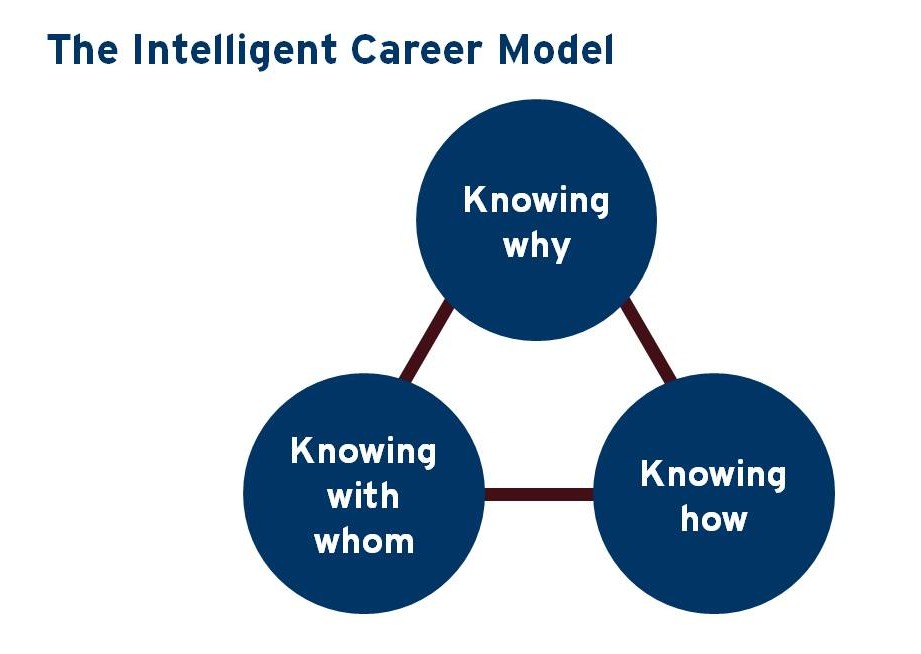
I like the Intelligent Career Model, because it’s easy to understand and provides really powerful insights to help you plan your next steps.
It’s based on having intelligence around three aspects of work: knowing why you work, knowing how you work best and knowing with whom you work best. Here’s a brief explanation of each, along with a short exercise to help you develop each kind of intelligence.
Knowing why: this is all about your values and drivers. What gets you out of bed in the morning? What makes you want to go and do great work? A career based on our values leads to much more fulfilment than doing work we can’t really engage and connect with on a deeper level.
Exercise: make a list of all the things that are important to you about work – whatever they might be. This might include making lots of money, being in a position of power, working for a prestigious brand or being a recognised expert in something. It can also include other aspects such as having an easy journey to work, being able to balance work and home life, having opportunities to develop and grow or working in a very sociable environment.
Come up with a list of at least 10-12 values. Now whittle that down to 5-6. What are the most important aspects for you? Which ones could you really not do without if you wanted a fulfilling job?
Those ‘most important’ values are the ones to base any future career decision on. If a promotion, job move or change of direction isn’t pressing all of those buttons you’re not going to find it very engaging for long.
Knowing how: this is all about your strengths and skills. We work best when playing to our strengths and deploying skills we enjoy using. You may have already done a strengths-based assessment in the past. Dig it out and review it – it will provide you with a reminder of how you work at your best.
Exercise: Draw a box in the middle of a piece of paper with four quadrants around it. Label the quadrants as follows: highly competent/enjoy using; requires development/enjoy using; highly competent/don’t enjoy using; and requires development/don’t enjoy using.
Now have a look at your CV or your LinkedIn profile and work through each role you’ve held, noting down all the skills that role called for. Any skills you feel indifferent about go in the box in the middle. But any that you have reasonably strong feelings about you should write in one of the four quadrants accordingly.
The competent/enjoy quadrant represents your strengths. The development/enjoy quadrant indicates career development opportunities. The competent/don’t enjoy quadrant are your exhausted skills and the development/don’t enjoy skills you should just steer clear of.
What we’re looking for are roles that allow you to use your strengths AND give you an opportunity to develop new skills you know you’d enjoy. We want minimal use of exhausted skills, as these don’t hold any enjoyment for you – even though you’re good at them, and don’t really want to have to do anything in the development/don’t enjoy quadrant. Especially if it’s a core component of the job.
This then becomes another decision making tool to help you weigh up or go looking for any future career opportunity.
Knowing with whom: this is all about the environment and the people you work best with. Relaxed, informal creative types or disciplined places with very smart, rational managers? The goal here is to uncover the right culture for you. A great job in the wrong kind of environment isn’t going to work for you longer term.
Exercise: for this we’re going to map your career and look for the themes and key influences that contributed to your career highs and lows. Draw a timeline across the centre of a page and mark it with an appropriate scale representing the years from when your career began to now. Draw a vertical axis representing career satisfaction and enjoyment from very high to very low.
Now plot your career, year by year or job by job, marking how enjoyable it was. When you look at the high points and the lows, add notes explaining why – was it the nature of the work, your line manager, your colleagues, the culture, etc?
This gives us further insights into what kind of environments and with whom you work best.
Pulling it all together
So now you have the three different kinds of intelligence that should enable you to plan what you want to do next with your career. First of all, assess your current role against each area – is it ticking all the boxes around your values? Are you mostly using skills you enjoy and are good at and is there scope for development? And do you find the environment and the people a good match?
Now you can use this intelligence to decide what next. If your current role scores highly on all three counts, is it likely to do so for the foreseeable future? Are there any risks to the stability or continuity your current role offers to be fulfilling?
If so, or if the current role is deficient in some way, what do you need to plug the gap? Closer alignment with your values, an opportunity to use or learn different skills or a different culture?
Use this framework to find out if the right combination exists elsewhere in your organisation or if you’re going to have to move to find it.
The Intelligent Career Model is a great tool to help make better informed career decisions. If you need to make time to work through it, why not do it when you’re on holiday?
 The World of Work Blog