Category Archives: Engagement

5 ways money can buy you happiness

Most of us work to earn money to fund a lifestyle. We often think that if we just had more money we’d be happier. Well, that depends on what you do with it.

An interesting challenge for banks right now is how they provide us with advice and services that help us manage our money better; rather than simply spend it.

Michael Norton, a professor at Harvard, has conducted some interesting research on how we can use money more wisely and increase our happiness. Here are his five principles:

  1. Buy experiences; not stuff. The anticipation and looking forward to the experience usually provides longer lasting gratification than the purchase of an item. And having the experience is interesting and enjoyable. Plus, looking back on an experience usually provides a better memory than the time when we bought a bigger TV.
  2. Buy time. It might be your dream to get out of the city and buy a big house in the country. But have you considered you might be buying yourself a two-hour commute? Perhaps a job move might require a drop in salary, but it gives you more time with family or less time travelling – which more than offsets the reduction in income.
  3. Pay now, consume later. Credit cards, of course, do the opposite – the instant hit with the bill that follows afterwards. Have you ever paid for a holiday when you’ve booked it and then when it comes time to go it almost feels like it’s free? When you’ve got money, use it to pay for things (or experiences!) you’ll make use of later.
  4. Make it a treat. We’ve all got into spending habits – coffee, wine, clothes – but these regular transactions become mundane. They lose the thrill they once provided. The way to get excited about them again is to give them up for a while. Take a week off from coffee and treat yourself next Monday morning. It will taste so good! Making things a treat involves spending less money and you’ll get more happiness out of it when you do go back to it!
  5. Spend it on someone else. Spending money on someone else reliably increases the spender’s happiness. And it can be quite a small amount to get a big reaction from the recipient, whether that’s a loved one, a donation to charity or some other altruistic expenditure.

These ideas come from Michael Norton’s book with Elizabeth Dunn, ‘Happy Money‘. He’s now focused on working with companies to help them educate and encourage their employees how to get more out of their money. As an employer, creating happier employees will have a direct impact on retention, engagement and customer service.

For some organisations – banks in particular – doing the same with customers could have huge benefits. Helping customers become better with their finances helps make them better, lower risk customers, more likely to take out higher margin products in future.

So it turns out money can buy us happiness, just not in the way we expected.
Assess your EVP and employer brand with the Marketing Exchange Circle

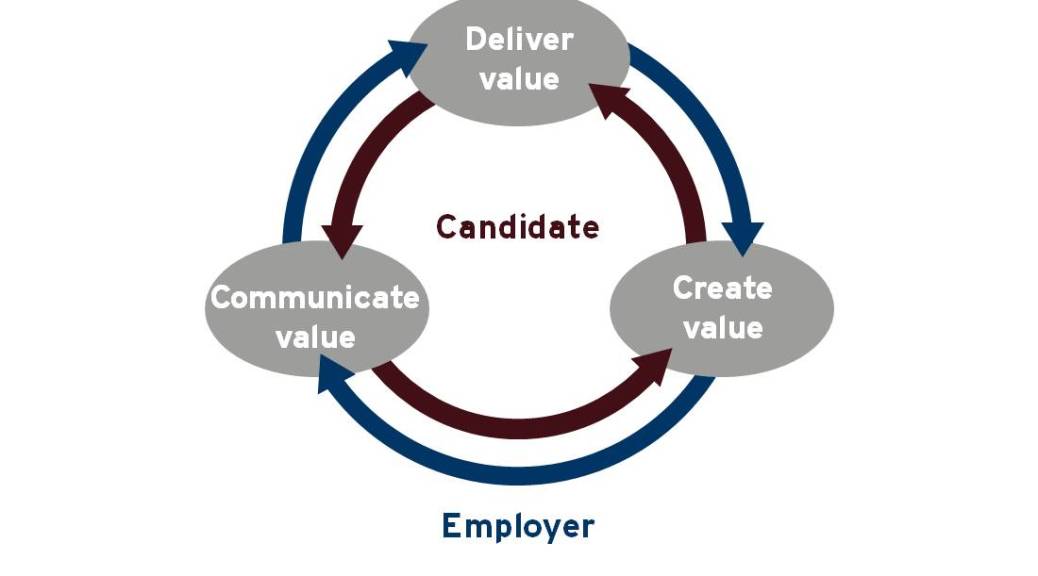
Most explanations of the marketing exchange process only explain a simple, single transaction: I give you currency in exchange for a product or service I value. The Marketing Exchange Circle, whilst still simple, explains the whole value creation process and is particularly relevant for people developing an employment value proposition (EVP) or employer brand. It was introduced to me a long time ago by one of my Marketing lecturers – Don Bathie (its creator).

First of all, the employer has to create something of value – the proposition. The offer to the talent marketplace to come and work here.

Marketing Exchange Circle

In my experience, the most critical element of this is making it different and distinctive from your competitors (the competition for talent, not necessarily the competitors for your consumers).

Marketing Exchange Circle

Then you have to communicate this value to the marketplace. You decide on the messages, the media, etc to convey the value you offer to the people you most want to attract, in the most compelling way. This is the promise you are making to potential employees.

Then, crucially, you have to deliver value. You have to keep your promise. And this includes everything from the onboarding experience you provide, the work environment and how the person’s line manager behaves, to the sort of work the person will be doing and how they will be rewarded, developed and recognised.

You will also have noticed that there’s a cycle going in the other direction. This represents the candidate and the exchange that takes place at each point in the circle.

Marketing Exchange Circle

Firstly, the candidate has to create something of value for the employer. This is the ‘talent’ they offer – the skills and experience they have accumulated that make them attractive to the organisation.

Then they have to deliver themselves to a touch point with the organisation. This could be finding a careers site, having a conversation with an existing employee that could refer them or crafting a LinkedIn profile that you notice.

The candidate and organisation then exchange information. The organisation gets valuable feedback on whether what it is communicating is successfully explaining the value on offer. Is the right talent engaging and responding? If not, the organisation needs to refine its recruitment marketing.

If it is, the candidate is likely to be attracted to the organisation and vice versa. During the selection process a further exchange of information lets each party assess the value on offer.

If the candidate then joins the organisation another exchange occurs as the candidate – now an employee – can feedback to the organisation whether the value proposition it created is sufficient to retain and engage that person. It will be obvious if it’s not through either a drop off in performance against expectations or attrition.

And so the cycle continues around the circle again – with the organisation using that feedback to refine and enhance its value proposition to take to market again; and the employee using the value he/she has derived to make himself/herself even more attractive and valuable to retain and/or promote. Otherwise the employee will leave and use their own enhanced value proposition to engage with another employer.

The Marketing Exchange Circle is a simple but very practical tool you can use to assess the strength of your EVP and brand:

  • Attrition data and exit interviews will tell you how you need to improve your value proposition
  • Attraction metrics will tell you if you’re communicating this effectively, and
  • Your offer acceptance rate and engagement scores will tell you if you’re delivering sufficient value

Any weak link in the circle will cause it to collapse.

I have found the Marketing Exchange Circle to be really useful in explaining the value creation process to people and helping them understand how what they do has an impact on what you are trying to achieve – whether that’s designing a proposition, communicating it or getting other parts of the organisation to deliver on the promise.