
Category Archives: Establishing career goals

How intelligent is your career?

I’d be willing to bet money that right now you’re probably spending more time planning your holiday than planning your career.

travel books feathered desat

In fact, for most people, it’s not just now, it’s on an annual basis! We spend more time thinking about where we’ll go, where we’ll stay and how we’ll get there for our two-week vacation than we do for the remaining fifty weeks of the year we’re at work.

What the last few years has shown us is that it pays to do a little proactive thinking around your career path; rather than wait for these unpredictable, turbulent times to hit us with a curve ball. Obviously, no-one has 20:20 vision when it comes to seeing into the future, but you can use some proven tools to be better prepared and be more in control.

The best I’ve ever come across is the Intelligent Career Model. This was developed in the early nineties by Arthur, Claman and DeFilippi in response to the last recession. It was based on ideas popular at the time around the Intelligent Enterprise – if an enterprise can learn from events round about it, so it will be better prepared to grow. The same is true of individuals and their careers. You can use this model yourself or when coaching others.
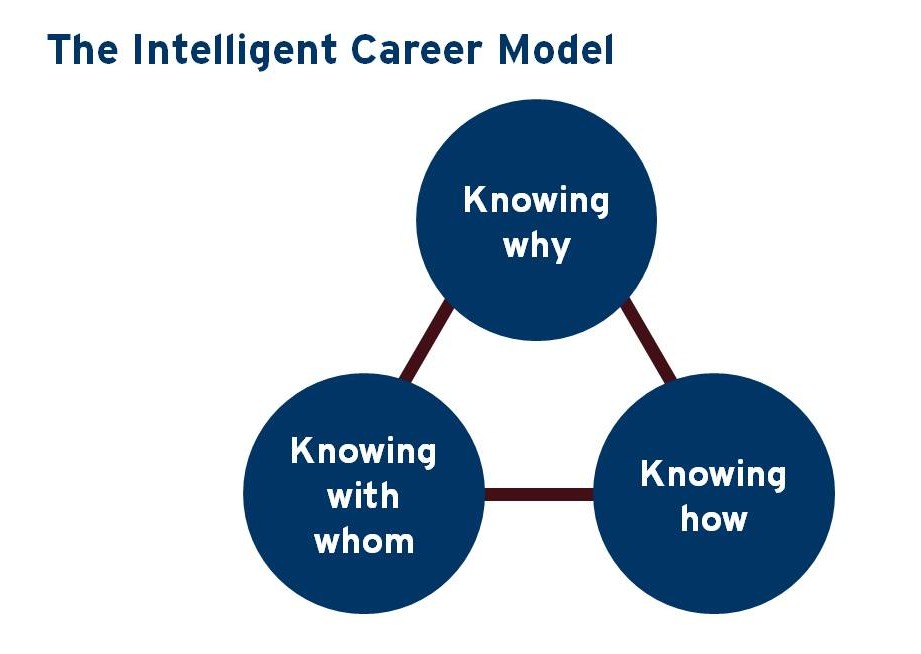
Intelligent Career Model

I like the Intelligent Career Model, because it’s easy to understand and provides really powerful insights to help you plan your next steps.

It’s based on having intelligence around three aspects of work: knowing why you work, knowing how you work best and knowing with whom you work best. Here’s a brief explanation of each, along with a short exercise to help you develop each kind of intelligence.

Knowing why: this is all about your values and drivers. What gets you out of bed in the morning? What makes you want to go and do great work? A career based on our values leads to much more fulfilment than doing work we can’t really engage and connect with on a deeper level.

Exercise: make a list of all the things that are important to you about work – whatever they might be. This might include making lots of money, being in a position of power, working for a prestigious brand or being a recognised expert in something. It can also include other aspects such as having an easy journey to work, being able to balance work and home life, having opportunities to develop and grow or working in a very sociable environment.

Come up with a list of at least 10-12 values. Now whittle that down to 5-6. What are the most important aspects for you? Which ones could you really not do without if you wanted a fulfilling job?

Those ‘most important’ values are the ones to base any future career decision on. If a promotion, job move or change of direction isn’t pressing all of those buttons you’re not going to find it very engaging for long.

Knowing how: this is all about your strengths and skills. We work best when playing to our strengths and deploying skills we enjoy using. You may have already done a strengths-based assessment in the past. Dig it out and review it – it will provide you with a reminder of how you work at your best.

Exercise: Draw a box in the middle of a piece of paper with four quadrants around it. Label the quadrants as follows: highly competent/enjoy using; requires development/enjoy using; highly competent/don’t enjoy using; and requires development/don’t enjoy using.

Now have a look at your CV or your LinkedIn profile and work through each role you’ve held, noting down all the skills that role called for. Any skills you feel indifferent about go in the box in the middle. But any that you have reasonably strong feelings about you should write in one of the four quadrants accordingly.

The competent/enjoy quadrant represents your strengths. The development/enjoy quadrant indicates career development opportunities. The competent/don’t enjoy quadrant are your exhausted skills and the development/don’t enjoy skills you should just steer clear of.

What we’re looking for are roles that allow you to use your strengths AND give you an opportunity to develop new skills you know you’d enjoy. We want minimal use of exhausted skills, as these don’t hold any enjoyment for you – even though you’re good at them, and don’t really want to have to do anything in the development/don’t enjoy quadrant. Especially if it’s a core component of the job.

This then becomes another decision making tool to help you weigh up or go looking for any future career opportunity.

Knowing with whom: this is all about the environment and the people you work best with. Relaxed, informal creative types or disciplined places with very smart, rational managers? The goal here is to uncover the right culture for you. A great job in the wrong kind of environment isn’t going to work for you longer term.

Exercise: for this we’re going to map your career and look for the themes and key influences that contributed to your career highs and lows. Draw a timeline across the centre of a page and mark it with an appropriate scale representing the years from when your career began to now. Draw a vertical axis representing career satisfaction and enjoyment from very high to very low.

Now plot your career, year by year or job by job, marking how enjoyable it was. When you look at the high points and the lows, add notes explaining why – was it the nature of the work, your line manager, your colleagues, the culture, etc?

This gives us further insights into what kind of environments and with whom you work best.

Pulling it all together

So now you have the three different kinds of intelligence that should enable you to plan what you want to do next with your career. First of all, assess your current role against each area – is it ticking all the boxes around your values? Are you mostly using skills you enjoy and are good at and is there scope for development? And do you find the environment and the people a good match?

Now you can use this intelligence to decide what next. If your current role scores highly on all three counts, is it likely to do so for the foreseeable future? Are there any risks to the stability or continuity your current role offers to be fulfilling?

If so, or if the current role is deficient in some way, what do you need to plug the gap? Closer alignment with your values, an opportunity to use or learn different skills or a different culture?

Use this framework to find out if the right combination exists elsewhere in your organisation or if you’re going to have to move to find it.

The Intelligent Career Model is a great tool to help make better informed career decisions. If you need to make time to work through it, why not do it when you’re on holiday?


What would you do if money were no object? Alan Watts on finding career fulfilment

Quite simply, this is three minutes of advice from Alan Watts on what should guide you in choosing a career path.

A careers lesson from mountaineers

Mountaineer

We spent a few days in Aviemore recently. I’ve never done any climbing, but I was reading an interview with a mountaineer who was asked ‘When do you get disheartened?’ His reply was, ‘When bad weather sets in’. But it wasn’t because the climb gets harder or more dangerous, it was because, ‘That’s when you lose sight of the peak’.

So in the midst of what might be an arduous climb he didn’t get disheartened because the conditions had got worse, it was because he had lost sight of his goal. He couldn’t clearly see the thing he was aiming for.

If you’re in the midst of climbing the career ladder and things seem tough, maybe it’s because you’ve lost sight of the goal you’re aiming for. Recreate it clearly and vividly. Use images, or write something down using descriptive language – use the senses and bring it to life.

That way when the career equivalent of bad weather sets in, you’ll still be able to see what you’re aiming for.

Any trance of a job?

Paul McKenna was speaking to a group of jobless young people at Hampden today – at a cost of £20,000!

Skills Development Scotland had brought him up here to boost the confidence of young unemployed people. Paul McKenna is good at what he does, and SDS argued that his slot would engage young people.

But that £20,000 could have funded 20 new apprenticeships.

Undoubtedly, confidence is a huge issue for job seekers. Especially for the long-term unemployed or young people with little work experience. But I don’t think this was the best use of taxpayers’ money.

Confidence is built when you experience a track record of success – for example, successfully completing application forms, gaining interviews, getting a work placement.

A ‘sugar high’ motivational confidence boost is all very well, but will it actually help people be more purposeful looking for work, be more motivated to apply for jobs and be more confident in interviews?

If you want to feel more confident in your job search, reflect on what you’ve achieved at each step in the process. Confidence comes from repeatedly having success at something – that doesn’t mean just landing a job – it’s successfully completing each step.

Who needs motivational speakers? Consider the successes you’ve had along the way, and in your career to date – successfully performing at interviews in the past, for example.

Unfortunately, getting a pep talk from a celebrity isn’t going to land you that dream job. Being clear on your career goal and focused on how to achieve it will. Go for it!

Firms fail to meet employees’ career aspirations

Today the Chartered Institute of Management published its survey results, which show some interesting things career wise:

Resignations have increased over the last year – and these aren’t redundancies – these are people leaving voluntarily. Requests for internal transfers are also down. So, despite the volatility in the jobs market, more people are choosing to pursue career opportunities elsewhere.

More than half the employers questioned (53.8 per cent) admitted that restructuring and job insecurity caused many of their staff to ‘jump ship’.  A significant proportion (38.5 per cent) recognised that their ‘failure to offer career opportunities and training’ contributed to employees leaving.  Given widespread recognition that engaged staff are more loyal, it is alarming that 61.5 per cent also admitted that their employees’ heads had been turned by head-hunters and recruitment consultants.

My sesnse of one of the best things to come out of this recession is a new intelligence about careers. I congratulate the people who’ve had the courage to move on to something better (sacrificing significant employment rights if they had more than a year’s service with the former employer), and I am disappointed that employers still don’t place enough emphasis on career management.

Too often, when someone hands in their notice, the manager says something like ‘I wish I’d known, I had big plans for you’. WHY DIDN’T YOU TELL THEM THEN?!

If you are considering a move, why don’t you take the initiative and ask for a chat with your manager about your career goals? You don’t have to be totally upfront with them about your desire to move on. Something like ‘I’ve been thinking about how I could add more value, and these are the things I’d like to focus on over the next year or so…’ will test the water. See if your manager responds with an open and authentic discussion about your career with the organisation.

In most cases, he/she won’t want to lose you and, assuming there’s a good cultural fit between you and the organisation, there are several advantages to staying with the same employer and shaping your job to play to your strengths more (longer holiday entitlement, established relationships, better visibility of new career opportunities, etc – and, if the worst does happen, your long service will entitle you to a bigger redundancy package).

So if your employer has been a bit remiss about helping you to manage your career, why don’t you get the ball rolling…..what have you got to lose? Looks like there’s still healthy demand for good people out there.

Ten careers that didn’t exist ten years ago

This article at Carerbuilder.com isn’t a scietific survey, but it does make you think about how technology, social and environmental trends are shaping careers.

It contains an interesting example of a career shifter: the customer service rep who became a full-time blogger and more than doubled his salary!

And ten years ago, who’d have thought you could get a job as a Green Funeral Director or a Social Media Strategist?

Dom Sagolla, co-creator of Twitter, is also quoted as saying his success is down to his efforts to position himself at the intersection of two emerging new industries – iPhone apps and social media.

Nice work if you can get it! Rather than trying to predict the next big thing to get into, look for the convergence of two industries – the intersection is going to create a real hot spot and demand for people who can capitalise on it.

Where did all the talent go?

Here’s an article I wrote for the January issue of HR Network Scotland (you can read the full magazine by clicking on the cover on the homepage).

It’s from the perspective of the employer, encouraging managers to be more proactive in having career development discussions with employees, but is also relevant to employees in terms of recommending they take the initiative and express their career aspirations to the boss.

If you’re suffering from New Year blues at present and are frustrated in your current role, why not follow the suggestions in this article? The solution to your job dis-satisfaction may be closer to home than you think:

“How many of your employees do you think have made New Year’s Resolutions to find another job?

Perhaps not right now, but if an upturn comes in your market over the course of this year a lot of them might be off. Exit interviews show that over 25% of leavers were moving for career advancement that their former employer could have offered them – if a conversation about career development had taken place sooner.

Do you talk to your employees about their future? Talented people want challenging assignments and good leadership. So successful career planning requires employer and employee to have mature conversations about ambitions, aspirations, potential, opportunities and growth.

So why don’t we discuss these issues? Why is HR so unsuccessful in running internal mobility initiatives? Underpinning this failure of communication is a lack of openness and clarity on both sides.

Employees are reluctant to voice their aspirations and long-term career goals for fear of jeopardising their job security. They don’t want their employer to think they are dissatisfied, disloyal or planning to leave. So they don’t ask for training or secondments that will allow them to develop the competencies they need to build on as part of their long-term career plan. Instead they leave for a role that they hope will allow them to develop these aspirational competencies.

It’s relatively rare for people to leave jobs where they are happy, even if offered higher pay, as most people prefer stability. But CIPD research shows lack of training and developmental opportunities are major reasons for staff turnover. If more organisations could get this bit right they’d improve their staff retention, make significant savings on recruitment costs and improve staff relations too.

Employers fear making the investment in training and developing people who will then leave. In addition, managers don’t necessarily advertise the fact that staff are top performers, as they don’t want to lose their best people to promotion or other departments. This means good staff aren’t enabled to fulfil their potential and may move on prematurely because managers aren’t committed to and engaged in the career planning and development process.

In an organisation that aims to anticipate human capital needs and meet them effectively, management needs to encourage dialogue about career paths, choices and opportunities. This sort of interaction can produce a win/win situation: employees improve their skills and competencies while the organisation benefits from an engaged and empowered workforce, enabled to realise their potential as well as their ambitions.

Ambitious people don’t want to wait for opportunities and often don’t have to – they move on. Good employees are looking for work that interests them and to increase their skills base. They want advancement, challenges and control over their careers. So processes and policies that go even part way to helping staff achieve their aspirations and ambitions will pay dividends. Building a talent pool is more efficient, less disruptive and cheaper than buying talent in!

Initiating such conversations may feel risky. Managers may feel that career decisions are best left to HR and top management. But balancing the interests of employer and employee is a strategic imperative if you want to protect your investment in development efforts. Employees need to willingly share their view of the future with their employers – and if career planning with their current employer can help them grow into what they want to be then that’s all to the good for both parties.

Management need to be educated in dealing with these risky conversations. They need to initiate dialogues with employees to address development needs and concerns. This has to be face-to-face. It may be sensitive, challenging and time-consuming. It requires imagination, courage and commitment on the part of the organisation. But the alternative is even more costly – losing your best people.

Openness in discussing career planning allows an organisation to improve its capability to spot talent, keep people motivated, stretched and challenged, whilst giving them appropriate support and development opportunities. Employees’ choices may not dovetail with organisational interests perfectly, but preserving the investment made in developing staff is a moveable feast. Meeting the needs of the organisation should take account of the preferences of all involved.

We all know that very few New Year’s Resolutions get acted upon – so why not demonstrate to your best employees that there really is no need to start surfing round the job boards? Start talking to them about their careers today.”

Who’s managing your career?

Happy New Year!

If you’re thinking about career goals for the year ahead, below is an article I wrote for the January edition of Edinburgh Chamber of Commerce’s ‘Business Comment’ magazine:

Most people spend more time planning a holiday than planning their career. If something goes wrong with your holiday you’ve usually got insurance to fall back on. If something goes wrong with your career, what’s your plan?

The new year is traditionally a time to set goals – why not put some effort into your career goals for the year ahead? If you’re at risk of redundancy, or affected by a merger, acquisition, or restructuring, you need a plan. If you’re an employer, or a manager responsible for the careers of others, you have a role to play in managing their careers too.

Despite everything that’s happening in the economy at present, the fundamentals of career management haven’t really changed in the last hundred years. As early as 1909, Frank Parsons, an American social reformer was counselling people on three things: know yourself; know the market for your skills and abilities; and know how to successfully marry the two.

Here are some tips on how to cover those three aspects of essential career management:

  1. Understand what you’re really good at and what you enjoy at work. What conditions need to be in place for you to perform at your best? What kind of people and environments help you achieve peak performance? If you’re stuck for answers, consider asking trusted colleagues and friends what they observe in you when you’re performing at your best.
  2. Explore the market for what you have to offer. Use your network, colleagues, friends and family, or tools like LinkedIn.com to research the kind of work people with your abilities are doing. Find out what’s happening in other sectors, even in other geographies, and determine where your skill set is in demand. Don’t be put off by negative reports about the economy – there is always demand for good people, you just need to know where to look.
  3. In terms of landing that dream job, within your current organisation or elsewhere, recent research amongst job seekers has shown that more proactive people find a new role almost twice as quickly as those who just browse for jobs. They are clear on what they want and focused on where and how they can add value, and they employ five or more routes into the job market – don’t just rely on job boards and newspaper ads. Use networking, trade publications, agencies, speculative applications, etc.


 And if you’re an employer, discuss all of the above with your staff. Exit interviews show that, when people leave an organisation for career advancement, their previous employer could have held onto them if their manager had been more proactive with career development discussions. There will be some people you want to keep and some whose career progression lies outside your organisation. Proactively managing their careers can have a huge ROI for you in terms of increased productivity, improved retention and more engagement.

New year career resolutions? Which world of work will you be in?

What do you think the future of work will look like over the next decade?

As 2009 closes, many of us will be considering new career objectives for the year ahead. But why not think longer term – where do you think you’ll be in 2020? As part of their ‘Managing Tomorrow’s People’ research series, PwC have put together a little quiz to help you forecast which world of work you’re headed for in 2020 – blue (corporate), green (sustainability and social values) or orange (small, collaborative networks). I was orange.

They also published a press release yesterday showing the effect of showing a little appreciation on employee loyalty:

One in three (33%) UK employees say they have not felt valued by their employer during the recession and would leave for another job if they could. Of those respondents who said their employer had shown appreciation for them in the downturn, 41% said they had no plans to leave as a consequence of this loyalty and just 23% said they would consider leaving regardless.

Either way, that means one in three or almost one in four people in every workplace is considering a career move – so now’s the time to do some prep and get ahead of the competition. Max Messmer, author of Managing Your Career For Dummies, offers ten New Year’s resolutions for your career here.

Whatever your career plans for 2010, I wish you all the best!

Re-thinking careers education

I stumbled across this:

“More than 20 years ago a generation of schoolchildren sat down to complete a questionnaire they were told would predict their future.”

Which is a BBC Scotland story about the Jiig-Cal computer in Edinburgh that reported back to an estimated four million pupils across the UK in the eighties about which career paths they should follow. I have vague memories of doing this questionnaire, although I can’t remember what my results were.

The article says that 70% of people went into jobs suggested for them by the computer – that doesn’t mean that they were the right jobs! It just shows how influential careers education or advice can be.

Fortunately, careers education has moved on a great deal since then. Unfortunately, I think it’s still hampered by an education system that is schooling people in ‘old world’ ways that are wholly inappropriate for our current reality. This is best articulated by Sir Ken Robinson in his TED Talk ‘Schools kill creativity’. If you have school-aged children, you have got to listen to this 18-minute talk. It could change the way you view their selection of subjects, which could have profound outcomes on their career success.

Some of Sir Ken’s ideas are explored further in Dan Pink’s book ‘A Whole New Mind’. If you are not the classic left-brain, MBA touting whizz-kid – fear not! The future for us in the west belongs to those who recognise and develop their right-brain (and, ultimately, whole-brain) capabilities.

So, if you’re in any form of career education at present, I would urge you to take account of some of this thinking that our current system is somewhat off the mark in terms of preparing people for happy and productive careers over the next 20-30 years.

And if you remember what the Jiig-Cal computer predicted for you, post it here!