
Category Archives: Self-awareness

How intelligent is your career?

I’d be willing to bet money that right now you’re probably spending more time planning your holiday than planning your career.

travel books feathered desat

In fact, for most people, it’s not just now, it’s on an annual basis! We spend more time thinking about where we’ll go, where we’ll stay and how we’ll get there for our two-week vacation than we do for the remaining fifty weeks of the year we’re at work.

What the last few years has shown us is that it pays to do a little proactive thinking around your career path; rather than wait for these unpredictable, turbulent times to hit us with a curve ball. Obviously, no-one has 20:20 vision when it comes to seeing into the future, but you can use some proven tools to be better prepared and be more in control.

The best I’ve ever come across is the Intelligent Career Model. This was developed in the early nineties by Arthur, Claman and DeFilippi in response to the last recession. It was based on ideas popular at the time around the Intelligent Enterprise – if an enterprise can learn from events round about it, so it will be better prepared to grow. The same is true of individuals and their careers. You can use this model yourself or when coaching others.
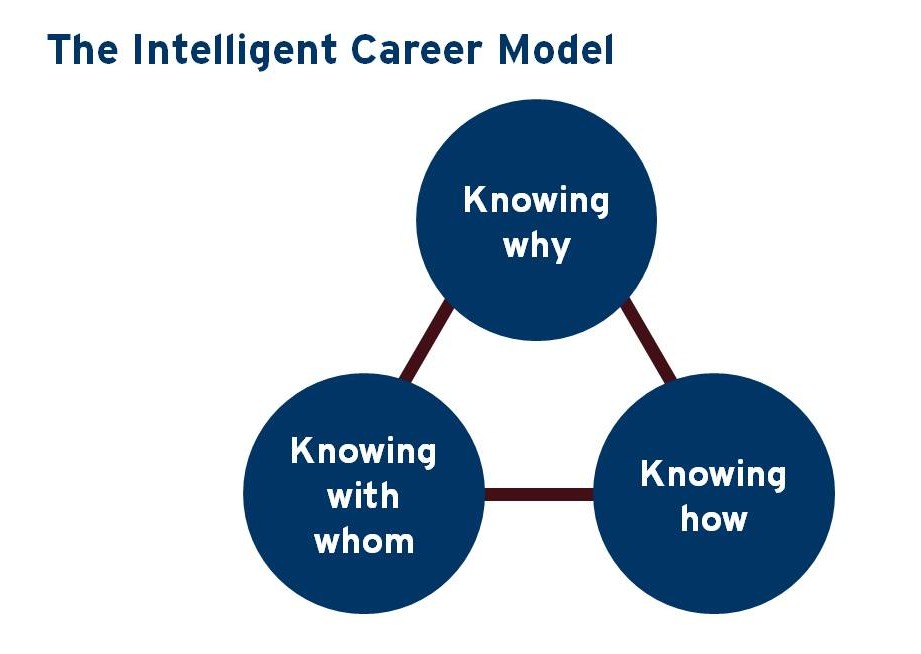
Intelligent Career Model

I like the Intelligent Career Model, because it’s easy to understand and provides really powerful insights to help you plan your next steps.

It’s based on having intelligence around three aspects of work: knowing why you work, knowing how you work best and knowing with whom you work best. Here’s a brief explanation of each, along with a short exercise to help you develop each kind of intelligence.

Knowing why: this is all about your values and drivers. What gets you out of bed in the morning? What makes you want to go and do great work? A career based on our values leads to much more fulfilment than doing work we can’t really engage and connect with on a deeper level.

Exercise: make a list of all the things that are important to you about work – whatever they might be. This might include making lots of money, being in a position of power, working for a prestigious brand or being a recognised expert in something. It can also include other aspects such as having an easy journey to work, being able to balance work and home life, having opportunities to develop and grow or working in a very sociable environment.

Come up with a list of at least 10-12 values. Now whittle that down to 5-6. What are the most important aspects for you? Which ones could you really not do without if you wanted a fulfilling job?

Those ‘most important’ values are the ones to base any future career decision on. If a promotion, job move or change of direction isn’t pressing all of those buttons you’re not going to find it very engaging for long.

Knowing how: this is all about your strengths and skills. We work best when playing to our strengths and deploying skills we enjoy using. You may have already done a strengths-based assessment in the past. Dig it out and review it – it will provide you with a reminder of how you work at your best.

Exercise: Draw a box in the middle of a piece of paper with four quadrants around it. Label the quadrants as follows: highly competent/enjoy using; requires development/enjoy using; highly competent/don’t enjoy using; and requires development/don’t enjoy using.

Now have a look at your CV or your LinkedIn profile and work through each role you’ve held, noting down all the skills that role called for. Any skills you feel indifferent about go in the box in the middle. But any that you have reasonably strong feelings about you should write in one of the four quadrants accordingly.

The competent/enjoy quadrant represents your strengths. The development/enjoy quadrant indicates career development opportunities. The competent/don’t enjoy quadrant are your exhausted skills and the development/don’t enjoy skills you should just steer clear of.

What we’re looking for are roles that allow you to use your strengths AND give you an opportunity to develop new skills you know you’d enjoy. We want minimal use of exhausted skills, as these don’t hold any enjoyment for you – even though you’re good at them, and don’t really want to have to do anything in the development/don’t enjoy quadrant. Especially if it’s a core component of the job.

This then becomes another decision making tool to help you weigh up or go looking for any future career opportunity.

Knowing with whom: this is all about the environment and the people you work best with. Relaxed, informal creative types or disciplined places with very smart, rational managers? The goal here is to uncover the right culture for you. A great job in the wrong kind of environment isn’t going to work for you longer term.

Exercise: for this we’re going to map your career and look for the themes and key influences that contributed to your career highs and lows. Draw a timeline across the centre of a page and mark it with an appropriate scale representing the years from when your career began to now. Draw a vertical axis representing career satisfaction and enjoyment from very high to very low.

Now plot your career, year by year or job by job, marking how enjoyable it was. When you look at the high points and the lows, add notes explaining why – was it the nature of the work, your line manager, your colleagues, the culture, etc?

This gives us further insights into what kind of environments and with whom you work best.

Pulling it all together

So now you have the three different kinds of intelligence that should enable you to plan what you want to do next with your career. First of all, assess your current role against each area – is it ticking all the boxes around your values? Are you mostly using skills you enjoy and are good at and is there scope for development? And do you find the environment and the people a good match?

Now you can use this intelligence to decide what next. If your current role scores highly on all three counts, is it likely to do so for the foreseeable future? Are there any risks to the stability or continuity your current role offers to be fulfilling?

If so, or if the current role is deficient in some way, what do you need to plug the gap? Closer alignment with your values, an opportunity to use or learn different skills or a different culture?

Use this framework to find out if the right combination exists elsewhere in your organisation or if you’re going to have to move to find it.

The Intelligent Career Model is a great tool to help make better informed career decisions. If you need to make time to work through it, why not do it when you’re on holiday?

What would you do if money were no object? Alan Watts on finding career fulfilment

Quite simply, this is three minutes of advice from Alan Watts on what should guide you in choosing a career path.

My very own career detour

detour1-271x300

Well, after a hiatus of just over three years (!) I’ve decided it’s time to start blogging again. Why now? Well, I’m now working in the career management field again, I’ve learned a lot over the last three years (some of which I think might be helpful for others), and I want an outlet for some of my thoughts and observations about work and careers.

So, here’s what’s been happening since my last post…

At the end of 2010 I got into a conversation about joining a bank as an internal HR Consultant. For various reasons, including having been in consultancy for ten years, it looked like a great move. It was an opportunity to apply some of the things I’d been helping clients do inside an organisation I was part of, it wouldn’t involve a sales target, it was a great package and they were saying all the right things. In April 2011 I moved.

It turned out not to be a good decision. The organisation’s culture just wasn’t for me (the last corporate HR role I was in, with a big retailer, ended for the same reason). I’ve come to trust my gut instinct over the years and, just at the point at which I was thinking ‘This isn’t working out’, I was called to a meeting by my boss. This was the end of 2011. I thought the meeting would be to discuss the projects I’d be working on the following year; but it turned out that I was caught up in another round of restructuring and was being made redundant. I felt a mixture of shock and relief.

The company provided outplacement support, which I took up (obviously!) Even though I’d been an outplacement practitioner for several years prior to this role, there were two questions I wanted to answer that I knew an impartial career coach could help with: ‘Is there a corporate HR role that would suit me – just not at this organisation?’ and, ‘If not, should I go back into consultancy or do my own thing?’

I was amazed at how the answer to the first question popped up just by doing a few basic exercises – a skills and values card sort and a career map. Clearly corporate HR roles did not play to my strengths, and a conversation with a headhunter made it clear that I couldn’t compete for them credibly against others who were in the market for those jobs.

So that left the second question. I had an idea for a business that would play to my strengths and it’s something I’d considered before. Again, using fundamental career decision tools the answer became clear: the risks and resources required in starting up a business (as the main breadwinner with two young children) outweighed the potential upside.

So very quickly I had a clear focus. A consultancy role. And the single most effective strategy to uncover new opportunities is networking – fortunately, something I’ve always sought to do since my very first days in a B2B role (see this previous post for a great networking philosophy).

One of my first calls was to a member of the Savile Group board; not to ask for a job, but because this person is so well connected – and I’d spent the last year immersed in building an internal network at the bank – that they could provide me with some useful market insights into what was happening in the big wide world and where I could look for new opportunities.

As it turned out, a combination of circumstances meant that there might be a new role at the Group and I was delighted to return in February 2012.

I can’t believe a year has passed already. I look back on my time at the bank as my career detour. I thought the grass was greener and inadvertently stepped into a role that didn’t suit me. I thought I had done sufficient due diligence and it was going to be a good move; but it wasn’t. Fortunately, employing some tried and tested career management techniques helped me land back in a role that I love.

A few client experiences have reminded me of my journey recently, and I thought it was about time that I started putting some of those thoughts in writing. I intend to post more regularly now and hope you get something useful from some of my ideas. Feedback and comments always welcome!

Who’s managing your career?

Happy New Year!

If you’re thinking about career goals for the year ahead, below is an article I wrote for the January edition of Edinburgh Chamber of Commerce’s ‘Business Comment’ magazine:

Most people spend more time planning a holiday than planning their career. If something goes wrong with your holiday you’ve usually got insurance to fall back on. If something goes wrong with your career, what’s your plan?

The new year is traditionally a time to set goals – why not put some effort into your career goals for the year ahead? If you’re at risk of redundancy, or affected by a merger, acquisition, or restructuring, you need a plan. If you’re an employer, or a manager responsible for the careers of others, you have a role to play in managing their careers too.

Despite everything that’s happening in the economy at present, the fundamentals of career management haven’t really changed in the last hundred years. As early as 1909, Frank Parsons, an American social reformer was counselling people on three things: know yourself; know the market for your skills and abilities; and know how to successfully marry the two.

Here are some tips on how to cover those three aspects of essential career management:

  1. Understand what you’re really good at and what you enjoy at work. What conditions need to be in place for you to perform at your best? What kind of people and environments help you achieve peak performance? If you’re stuck for answers, consider asking trusted colleagues and friends what they observe in you when you’re performing at your best.
  2. Explore the market for what you have to offer. Use your network, colleagues, friends and family, or tools like LinkedIn.com to research the kind of work people with your abilities are doing. Find out what’s happening in other sectors, even in other geographies, and determine where your skill set is in demand. Don’t be put off by negative reports about the economy – there is always demand for good people, you just need to know where to look.
  3. In terms of landing that dream job, within your current organisation or elsewhere, recent research amongst job seekers has shown that more proactive people find a new role almost twice as quickly as those who just browse for jobs. They are clear on what they want and focused on where and how they can add value, and they employ five or more routes into the job market – don’t just rely on job boards and newspaper ads. Use networking, trade publications, agencies, speculative applications, etc.


 And if you’re an employer, discuss all of the above with your staff. Exit interviews show that, when people leave an organisation for career advancement, their previous employer could have held onto them if their manager had been more proactive with career development discussions. There will be some people you want to keep and some whose career progression lies outside your organisation. Proactively managing their careers can have a huge ROI for you in terms of increased productivity, improved retention and more engagement.

Re-thinking careers education

I stumbled across this:

“More than 20 years ago a generation of schoolchildren sat down to complete a questionnaire they were told would predict their future.”

Which is a BBC Scotland story about the Jiig-Cal computer in Edinburgh that reported back to an estimated four million pupils across the UK in the eighties about which career paths they should follow. I have vague memories of doing this questionnaire, although I can’t remember what my results were.

The article says that 70% of people went into jobs suggested for them by the computer – that doesn’t mean that they were the right jobs! It just shows how influential careers education or advice can be.

Fortunately, careers education has moved on a great deal since then. Unfortunately, I think it’s still hampered by an education system that is schooling people in ‘old world’ ways that are wholly inappropriate for our current reality. This is best articulated by Sir Ken Robinson in his TED Talk ‘Schools kill creativity’. If you have school-aged children, you have got to listen to this 18-minute talk. It could change the way you view their selection of subjects, which could have profound outcomes on their career success.

Some of Sir Ken’s ideas are explored further in Dan Pink’s book ‘A Whole New Mind’. If you are not the classic left-brain, MBA touting whizz-kid – fear not! The future for us in the west belongs to those who recognise and develop their right-brain (and, ultimately, whole-brain) capabilities.

So, if you’re in any form of career education at present, I would urge you to take account of some of this thinking that our current system is somewhat off the mark in terms of preparing people for happy and productive careers over the next 20-30 years.

And if you remember what the Jiig-Cal computer predicted for you, post it here!

Are you cut out for a move cross-sector?

I recently attended a session on the Hogan Dark Side assessment. This instrument looks at 11 areas of strength (such as enthusiasm, focus, confidence, etc.) and measures which of these factors will flip into a ‘Dark Side’ characteristic when over-done under pressure. For example, confidence over-done becomes arrogance; enthusiasm becomes volatility, etc. I found the tool itself very useful, and what particularly interested me was the variation in norm group scores across different generations and between the public and private sectors.

There’s not a lot you can do about your age, although, if you’re in a management position, it is worth noting that your reactions to stress and pressure will probably be different to your colleagues in other generations (Gen X, Gen Y or Baby Boomers) – therefore they need to be managed differently.

The career management point I want to make is that there do seem to be some fundamental differences between what makes public sector workers tick compared to those from the private sector. Under pressure (and who isn’t at present?) the two groups react very differently:

Public sector workers become more cautious, detached and dependent; whilst private sector workers veer into displaying arrogance, becoming more manipulative and being dramatic.

These are quite stark differences. It suggests to me that the prevailing culture within the public sector is “Don’t take any risks, batten down the hatches, just follow orders”; whilst in the private sector it’s “Talk yourself out of it, take what you can, go over the top with emotion”. Stereotypical? Perhaps, but the data backs it up (statistics never lie, do they?)

This is a UK sample of over 18,000 – so statistically significant. And for the careerist, perhaps considering a move cross-sector right now, the question has to be ‘Am I cut out for this kind of environment?’

I know there are many parts of the public sector wanting to get more commercial and they are bringing in private sector expertise; and there are plenty of private sector organisations that would benefit from a more cautious approach.

In my experience, though, people who move across sectors expecting that they can single-handedly change things, very quickly succumb to pressure to conform or get spat out. I’m not suggesting you don’t consider a move cross-sector – there are some very exciting opportunities out there when you broaden your horizons – but go in with your eyes open, understanding that you will experience some culture shock, whichever way you move.

The people I know who have successfully made the move have done so on an interim or consultancy basis initially – experimenting with ‘the other side’, and taking the time to find their niche, before committing to it whole-heartedly.

My advice – explore all the options, network with people already operating in the area you are considering moving into and then test it out in some way if it appeals. Recognise that there are fundamental differences in the MO between the public and private sectors and you’ll probably assimilate pretty well.

Have you got experience moving cross-sector? If so, post a comment…